The Golden Age of Artist-Drawn Picture Postcards
stanley t. chaplin
(?-?)
I. The Twelve Cards
“From Ghoulies and Ghosties/ And Long-leggety Beasties/ And things that go bump in the night,/ Good Lord deliver us.”
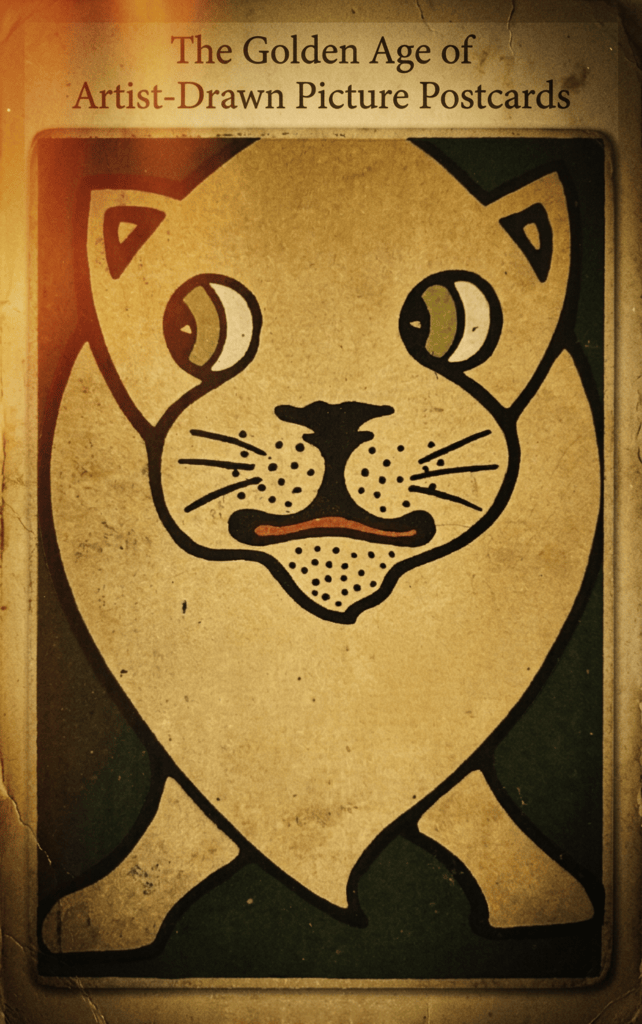
Not overly difficult to find, but very peculiar and attractive are twelve postcards drawn by Stanley T. Chaplin and published by Harvey Barton & Son in Bristol in the late 1920s. Nothing is known about Chaplin. His legacy, apart from a few unremarkable and rather bland postcards that show buildings in Salisbury and Rye, consists in these twelve cards, which illustrate an old prayer commonly known as the Cornish Litany: “From Ghoulies and Ghosties/ And Long-leggety Beasties/ And things that go bump in the night,/ Good Lord deliver us.” It is unclear where the Cornish Litany comes from or how old it is. At least I haven’t been able to find out anything decisive. I love the verse, though, which strikes me as catchy and highly suggestive.
II. On the Litany
On the one hand, the Cornish Litany seems to speak of a world that is full of horrors, from which we need protection that only a benevolent and powerful God can give us. Ghouls and ghosts give names to certain elementary fears, which are easy to push aside during the day when there is light and company, and much harder to overcome when you’re alone and it’s dark outside. A ghoul is a monster that will eat you up when given half a chance, that will tear you apart, limb by limb, and then devour what remains of you until there is nothing left. Ghouls, in other words, represent death and the subsequent dissolution of the living body that lies ahead of all of us and that some philosophers (quite wrongly, I think) have dubbed the “greatest evil”. Quite the opposite is expressed by the word ‘ghost’. A ghost is what remains of a person when their body has died. It is a once-living and once-human spirit that refuses to leave, to give up its existence on earth. It continues to be around when by rights it ought to be dead and gone for good. Ghouls and ghosts represent the two opposing existential fears: the fear of death, and the fear of eternal life, or more precisely, of not being able to die.
Yet on the other hand the Cornish Litany makes these monsters lurking in the shadows of our lives appear strangely familiar, like old acquaintances, no doubt worrying, a bit frightening perhaps, but also very much a part of our everyday lives which we have almost gotten used to and have learned to live with. Not ghouls and ghosts, big and strong and meaning business, but ghoulies and ghosties and long-leggety beasties, which certainly sound unpleasant, but not seriously dangerous, like spiders with their (far too) many long and fast legs, whose touch we loathe with no good reason but very strongly nonetheless. And the things that go bump in the night, things of which we don’t know what they are, that don’t even have a name or face, that are just a sudden, unexpected sound in the dark – those things capture the essence of fear itself: the fear of the unknown (for which the German word angst may be more appropriate than the English word fear). Yet again, at the same time, a thing that goes bump in the night, for all that it stands for, is only potentially perilous and does not represent a real, concrete danger. The thing that goes bump in the night is never a burglar who will enter the house the very next moment to rob and perhaps hurt you. It remains just that: a noise in the dark. Similarly, the ghoulies and ghosties stay in the wardrobe or under the bed, a permanent threatening presence, but actually quite harmless. The Cornish Litany is a child’s prayer, which makes us look at the world from a child’s perspective, as a place that is home to innumerable dark forces, which, however, fail to materialise and to unleash their power, as long, that is, as you have a good hiding place. A warm bed and a blanket to pull over you will do just fine. In blessed innocence, and quite charmingly, the prayer knows nothing yet of the real horrors of this world, from which no blanket can protect us.
III. Other Hands
The Cornish Litany has been illustrated by other postcard artists, most of which, quite in accordance with the spirit of the litany, have a slightly humorous touch. On some cards the wording of the litany has been adapted to a new place, so that the Cornish Litany becomes for instance the Dartmoor Litany, which expresses somewhat more worldly concerns, but is, though moderately funny, a good deal less charming than the original: “From Wizards and Buzzards/ And Long Tailed Lizards/ And Things that Creep/ Through Other Folks Hedges/ Good Lord Deliver us.” Another example is the Old Sussex Yeoman’s Litany: “From Flints and Sands/ And Barren Lands/ Good Fortune set me Free;/ From Sound of Guns/ and Women’s Tongues/ Good Lord deliver me.” This is all nicely done but does not achieve the haunting simplicity of the original.
IV. Collector’s Note
With the possible exception of one card that was created by the marvellous Arthur Wragg and published by Polperro Press a few years earlier, the twelve cards drawn by Stanley T. Chaplin are by far the best of the lot. These cards can be found in three different versions: black and white; black, white and green; and black, white, green, and purple.


